
The Ultimate Guide to Live Stream Frame and Bit Rates
Are you having trouble determining which frame rate or bit rate you should be using? Don't fear, in this reference guide we're going to find out which settings you need to be using for your live stream.


Are you having trouble determining which frame rate or bit rate you should be using? Don't fear, in this reference guide we're going to find out which settings you need to be using for your live stream. First, let's establish what bit rate and frame rate means...
Frame Rates
As you're probably aware videos don't actually move. Instead, they're an optical illusion that makes you perceive motion. To create a video a camera takes lots of photos every second (the frequency of those photos being the frame rate) and then your display shows them back to back at the same rate. Because our brains naturally try to "connect the dots" we perceive motion even though it's really just a super-fast slideshow of photos.
The same principles from early film cameras apply (see gif below), but rather than a long sequence of tiny photos rolling in front of a light source, images are displayed on a digital display.

The most common frame rates at least in the U.S are 30fps, 24fps, 60fps, and 120fps. 24pfs is commonly used in movies because it was once the standard back in the film days. Something about that look seems to have stuck around. 30fps is the defacto internet standard frame rate. It provides enough frames to capture most motion and doesn't look too fake.
Both 60fps and 120fps are found typically in sports and some broadcast TV. Because of the fast movement occurring in most sports, it's necessary to capture in a higher frame rate. The downside is that for some reason video at these frame rates appears fake or not as realistic compared to 30fps or 24fps.
Which one do I need? Most streaming destinations either don't support or don't recommend 24fps. So don't do that. 60fps and above start to look a bit fake and the extra frames aren't necessary because there shouldn't be much dramatic motion in most church live streams. That leaves 30fps, the internet "standard." Funny how that worked out, right? The standard still stands.
Bit Rates
Okay, so videos are made up of many photos in sequence and the rate the photos are taken is called the frame rate but what does bit rate mean?
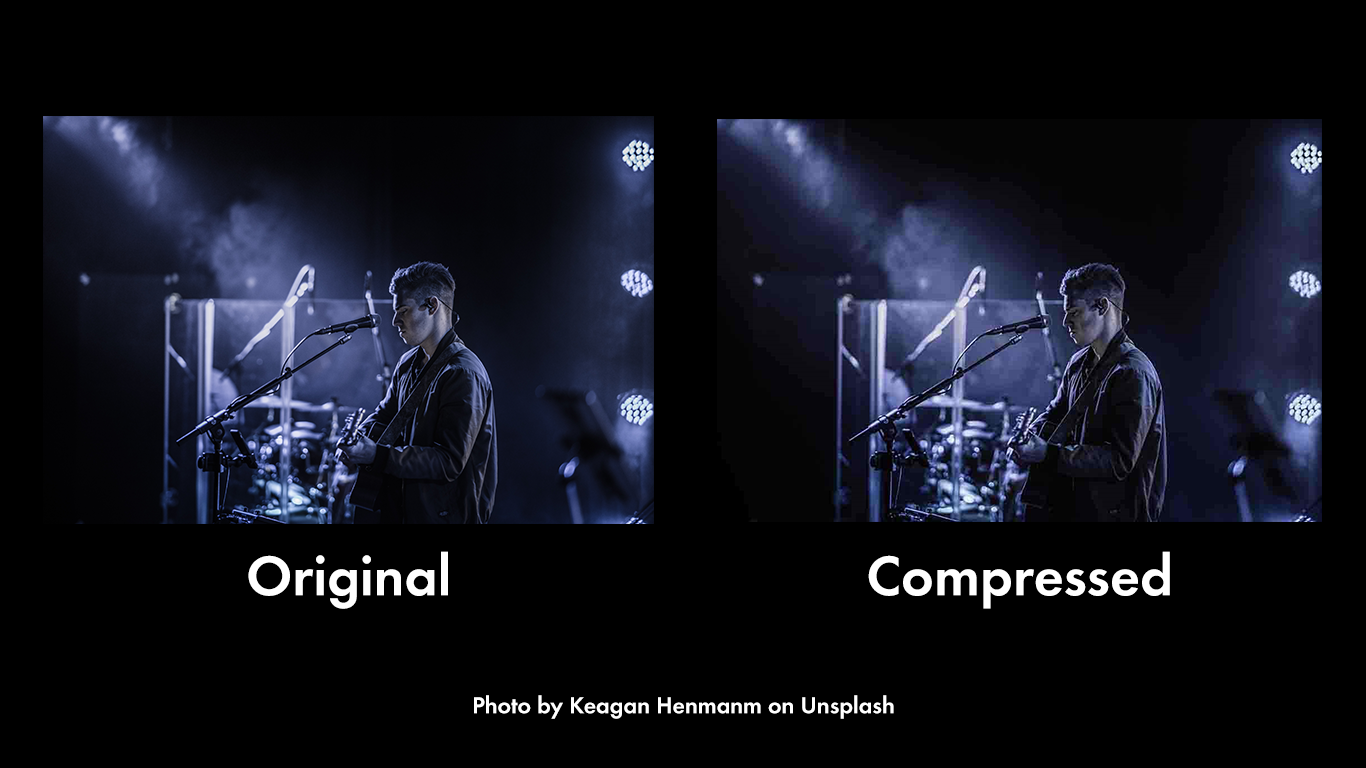
Because the amount of data (information) taken in by a camera's sensor is often quite large we use compression. The above example photo was about 6MB originally but after compression, it is 0.02MB. That's a huge saving when you're needing to upload or download 30 of them every second.
We all have finite upload and download internet speeds so rather than having to wait forever to download each frame of video we compress things down. The amount of data we send each second is called the bitrate. For HD video <10 Mbps is common with 4k content sometimes reaching as high as 50 Mbps.

Now that we've covered some basics let's look at what encoding settings some common platforms want.
Reference Guide

Facebook Live Recommended Encoder Settings:
Facebook Live - 1080p @ 60 fps
Facebook Live - 1080p @ 30fps
Facebook Live - 720p @ 60 fps
Facebook Live - 720p @ 30 fps
Facebook Live - 480p @ 30 fps

YouTube Live Recommended Encoder Settings:
YouTube Live - 4k @ 60fps
YouTube Live - 4k @ 30fps
YouTube Live - 1080p @ 60fps
YouTube Live - 1080p @ 30fps
YouTube Live - 720p @ 60fps
YouTube Live - 720p @ 30fps
YouTube Live - 480p @ 30fps

Vimeo Live Recommended Encoder Settings:
General Encoding Settings

Restream.io Recommended Encoder Settings:
Restream.io has overall limitations (meaning any stream sent to them must follow these) and then each platform (ex: Facebook, YouTube, etc) have their own limitations. If you're using Restream.io you'll need to follow the overall limitations and limitations for your respective platforms.
Al revisar cómo elegir una camiseta de fútbol para un coleccionista, conviene empezar por el escudo, el cuello y la disposición de los patrocinadores. Como comprobación final, conviene asegurarse de que la referencia del modelo corresponda a la temporada buscada.
Restream.io Limitations
Restream.io Facebook Limitations
Restream.io Twitter Limitations
Restream.io Twitch Limitations
Restream.io LinkedIn Limitations
Restream.io YouTube Limitations

Mux Live Recommended Encoder Settings:
Mux has three different tiers of recommended settings ranked by how well they will work.